
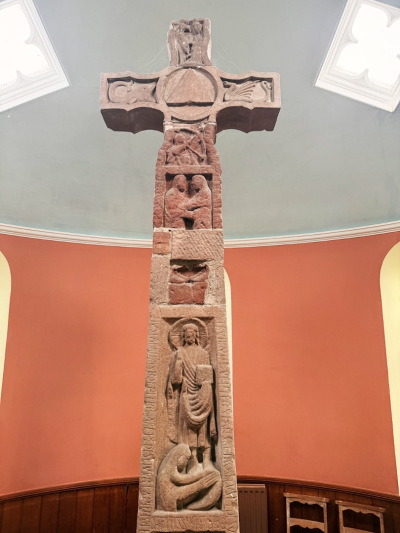
The Ruthwell Cross is one of the few treasures to have survived from Angles' conquest and settlement of the south of what is now Scotland.
The Angles who carved out the Kingdom of Bernicia were pagans, worshipping gods like Woden, an Anglo-Saxon equivalent of the Norse god Odin.
All of this changed in 635AD when two brothers, Oswald and Oswui, returned from exile at the monastery on the holy Isle of Iona, to reclaim their kingdom and brought Gaelic missionaries with them.
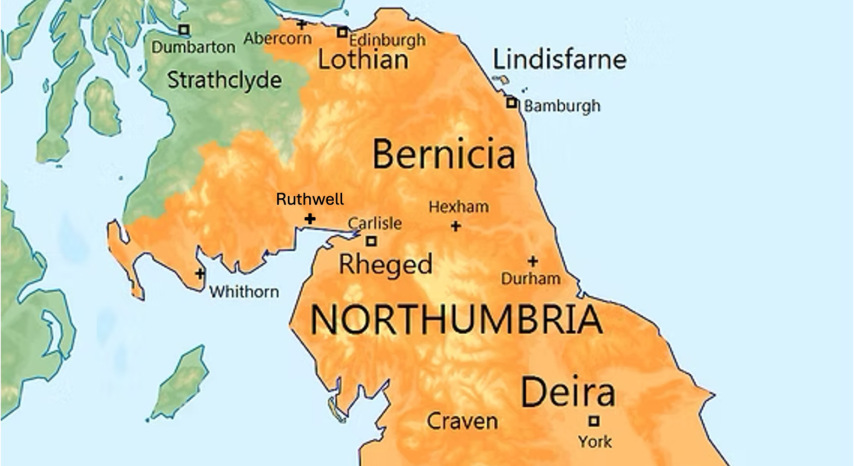
The Ruthwell Cross is a symbol of the Angles' control of the area, but also their Christian faith. The cross stands 5.2 metres tall and is carved with beautiful imagery. It was possibly erected around 700AD, and it would have stood outside as a preaching cross, using the carvings as a picture book for the 'humble'.
The Ruthwell Cross has the largest carved pictures (called reliefs) found on any Anglo-Saxon cross. These carvings are also some of the biggest Anglo-Saxon carvings still existing. On the front and rear of the cross are carved scenes that illustrate Christ's divinity, the Holy Trinity and the four Evangelists who wrote the gospels - Matthew, Mark, Luke and John.
Latin inscriptions around the reliefs tell the story of what is pictured on the cross, this was probably used by the monks as they would be the only people who had a Latin education.
A second set of inscriptions called runes are also carved, these were used by Germanic peoples (Angles and Vikings). They are quotation fragments from one of the oldest Old English poems 'The Dream of the Rood' ('rood' means cross).
The runes may have been for those with no knowledge of Latin, but who possibly knew the poem by heart. It tells the story of the Crucifixion from the perspective of the Cross, it mixes bloody warrior imagery, of a kind the Angles would appreciate, with the understanding of Christ's suffering.
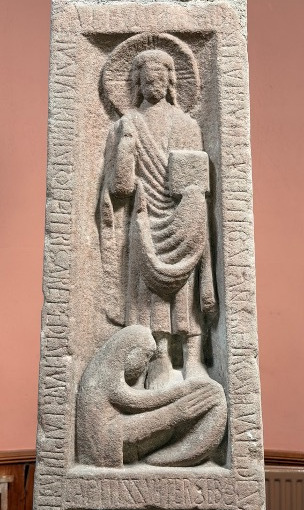
This relief shows the repentant woman (Mary Magdalene) washing Christ's feet.
Latin inscription translated:
'She brought an alabaster box of ointment; standing beside his feet, she began to moisten his feet with tears, and dried them with the hair of her own head.'
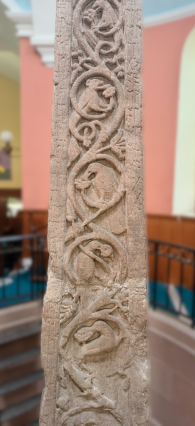
The inscriptions on the sides of the Cross are a version of the religious poem 'The Dream of the Rood' the earliest dream poem and one of the finest religious poems.
Written in runes and translate as below:
Christ was on the cross.
Nevertheless hastening ones came there from afar to the Lord,
I beheld all that.
I was grievously troubled with sorrows.
I bowed [to the hands of men] ...
With arrows wounded.
They laid him down, limb-weary, they stood [at] his body's head.
There they beheld [the lord of heaven].
Hear the verse spoken in Anglo-Saxon Old English.
You can explore the reliefs of the Ruthwell Cross and their meaning using this 3D scanned rendering.